What changes this decision in the UK?
Technical fit, commercial package and legal authority are three separate checks. A detector specification helps select equipment; a written quote fixes the package; landowner permission and the relevant heritage or foreshore rules determine whether and how the site may be searched.
- Follow the current manual: automatic, tracking and manual ground procedures are not interchangeable.
- Move away from metal, fencing and buried services before assessing ground response.
- Salt response is not the same as inland mineral variation; begin with the relevant beach profile.
ground balance metal detector UK at a glance
| Stage | Action | Record |
|---|---|---|
| 1. Site check | Choose a clean patch and scan for metal | Moisture, fencing, power noise |
| 2. Noise control | Run the recommended noise procedure | Channel or automatic result |
| 3. Ground procedure | Use the manual’s pump, tracking or automatic routine | Mode and value if shown |
| 4. Reference target | Sweep a known target from two directions | Height, audio, ID stability |
| 5. One-variable test | Change only sensitivity, recovery or balance | Before-and-after response |
Separate electrical noise from ground response
A detector that chatters near power, electric fencing or another detector may not have a ground-balance problem. Begin with the coil away from obvious metal, inspect the area and use the manufacturer’s noise-cancellation or frequency-shift procedure where provided. Assess ground response only after interference is reasonably controlled.
Do not raise sensitivity to compensate for an unstable baseline. A quieter, repeatable setting can cover ground more effectively because uncertain signals need fewer rescans. Note nearby interference and the chosen mode so a later change is not incorrectly attributed to soil.
Use the exact model’s ground procedure
Ground balance may be automatic, manual, tracking or managed within a multi-frequency profile. Follow the current manual and use a patch free from a confirmed metal target. If the routine requires pumping the coil, keep the motion controlled and avoid striking grass or soil.
After the procedure, sweep a known target from two directions at a realistic height. If response remains unstable, reduce sensitivity or revisit noise control before changing several advanced settings. Recording the sequence prevents a collection of untraceable adjustments.
Adapt carefully to damp pasture and cultivated soil
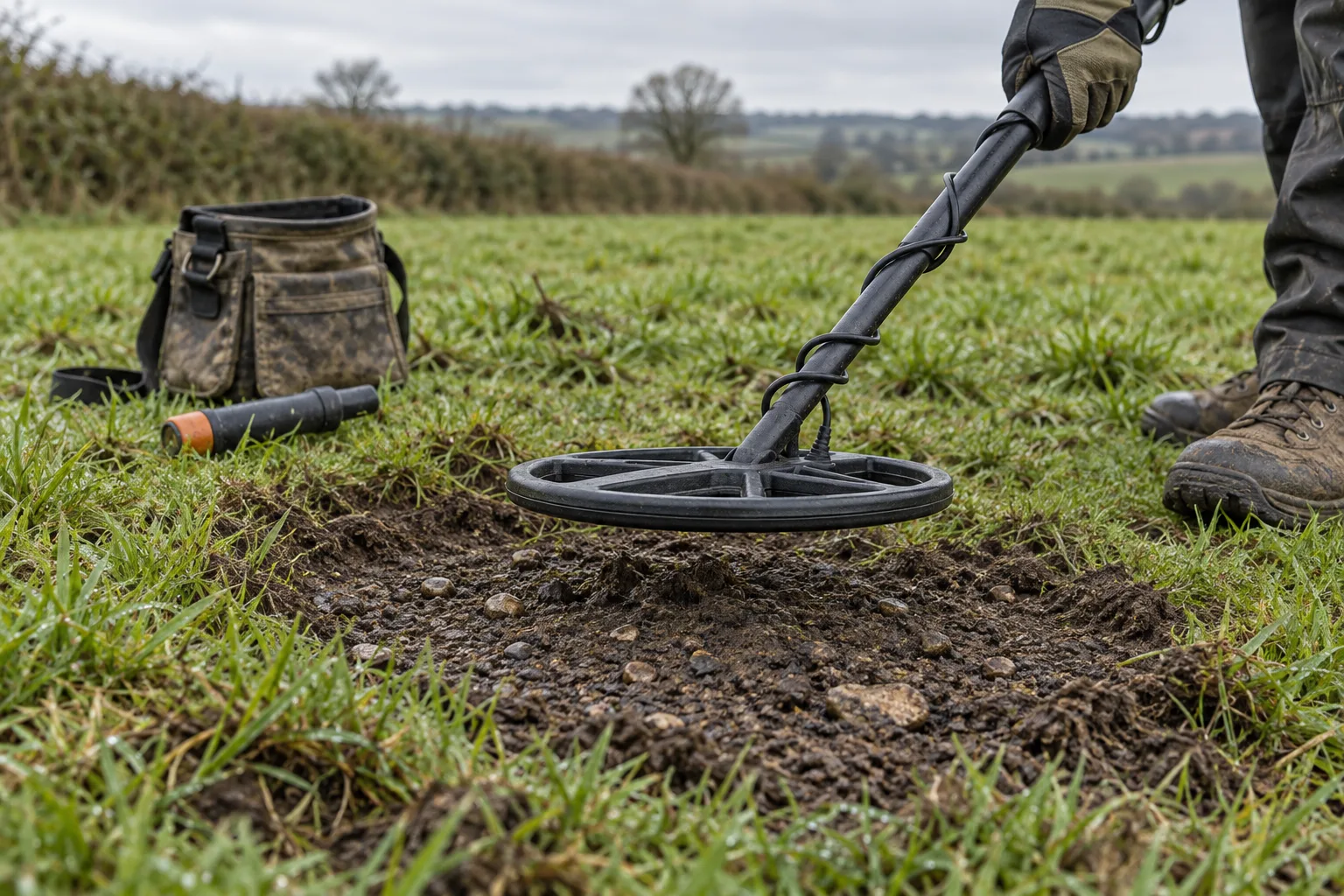
Moisture and changing soil can alter response across a field. Repeat the recommended balance procedure when site character changes materially, not after every isolated target. Keep coil height steady over ruts and long grass; height changes can sound like target changes and make comparison impossible.
Use a reference object only where lawful and safe, and recover it after testing. Compare the same mode, height and direction before altering one variable. The resulting notebook is specific to your permission and machine, which is more useful than copying an unexplained internet setting.
Treat salt beaches as a dedicated setup problem
Wet conductive sand and moving saltwater can require the manufacturer’s Beach or Multi-Salt route. The X-TERRA ELITE publishes Beach profiles, while the Vortex VX9 lists Multi-Salt. Begin there and make measured adjustments rather than transferring an inland setting unchanged.
Check waterproof headphones, seals and rinse instructions before entering surf. Retest when moving between dry sand, wet sand and water because the environment changes. Permission and foreshore ownership must already be resolved; setup deals only with detector behaviour.
Manufacturer and official authority sources
Checked 2026-09-15. Reopen the current source before relying on a specification, package detail or legal route.
Questions about ground balance metal detector UK
Should I ground balance before every target?
No general rule applies. Follow the model manual and repeat the procedure when site conditions or stability materially change.
Is maximum sensitivity always deeper?
No. An unstable setting can reduce usable information. Compare repeatability while changing one control at a time.
Can I use pasture settings on wet salt sand?
Start with the manufacturer’s relevant Beach or Multi-Salt profile; wet conductive sand is a different operating condition.